


Thru-hiking Gear Review - SlingFin SplitWing UL Tarp
Planning an adventure? Check out our popular trail guides! 4.8 stars (17K+ ratings)


Photo provided by Dahn Pratt
SlingFin SplitWing UL Tarp Review
The SlingFin SplitWing UL Tarp provides a unique value proposition. Lightweight glory without the price-tag heartache!
Dahn Pratt Gear Review 07/10/2020
Dahn Pratt
Gear Review
07/10/2020
SlingFin SplitWing UL Tarp Review
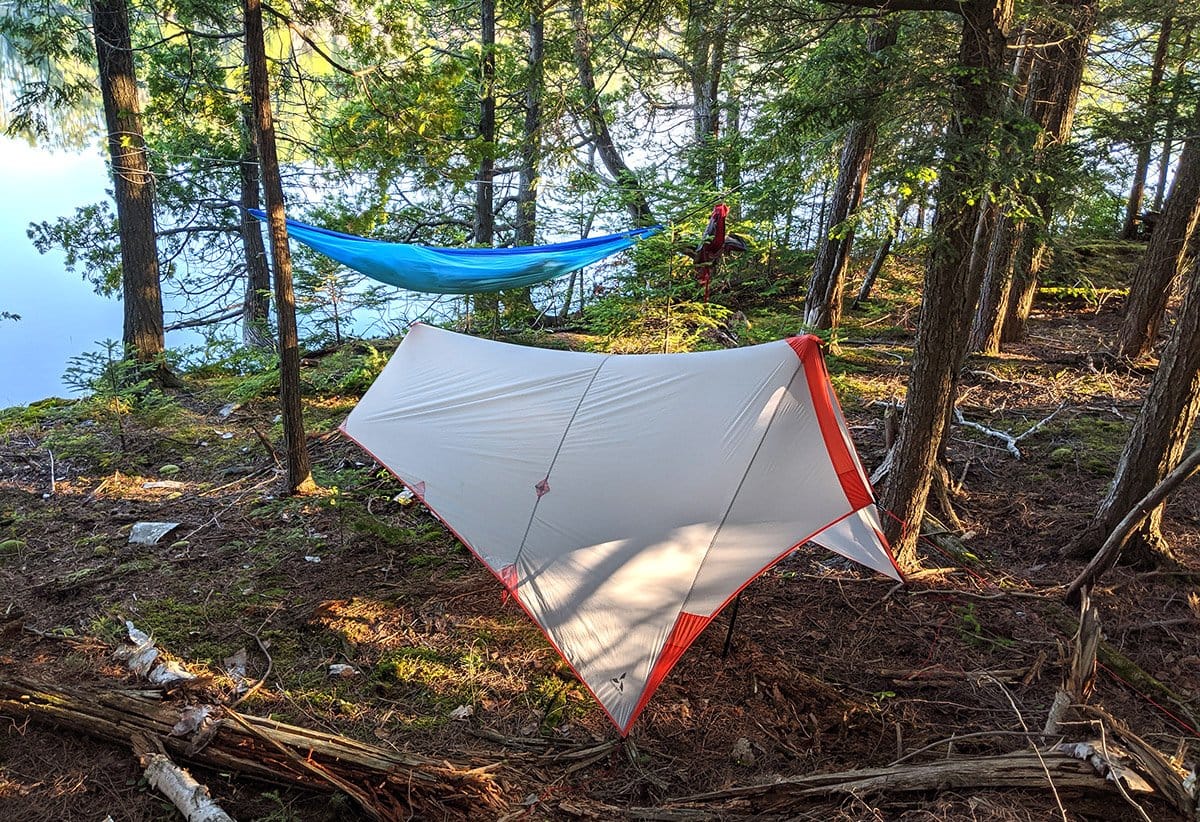
SlingFin recently introduced a new tarp to its offering of shelters. I got to try out the Splitwing UL Tarp for the last two months and have been pretty impressed with its weight to cost ratio, as well as its weather worthiness.
First some specs:
My SplitWing tarp was a scant 7.9 oz (as advertised) and with all guylines, stakes, and stuff sack weighed just 11.3 oz, a bit more than the advertised 11.1 oz on the website, but a negligible difference. *Please note this is for the tarp and the weight does not include the modular components that can work with the tarp (foot print, mesh, vestibule beak).
The tarp is made out of 10D Nylon 66 Ripstop Sil/Sil with a 30D weight at the tarp’s reinforcements points. SlingFin claims that this fabric,
“…[W]on’t hydrolyze like PU coated fabrics and absorbs less water so it doesn’t sag as much as PU coated fabrics and makes it resistant to mold and mildew growth.”
I’m not really sure what hydrolyzation is but sounds good to me!
What I like about the Splitwing UL Tarp

Photo by Dahn Pratt
Lightweight & reasonable price – I was especially impressed with the weight for a non-Dyneema shelter, not to mention the MSRP (cost) of the SplitWing of $164.99. For reference, comparably weighted shelters can be in the $400 – $600+ range when Dyneema Composite is the textile of choice.
Super packable – I was also impressed with how packable the Nylon66 fabric is. I often baby my Dyneema gear when putting it in my pack for fear of damaging the fabric. As most long distance hikers know, Dyneema is not very abrasion resistant. On a long hike, holes and degraded fabric are a foregone conclusion. It’s still too soon to speak to the longevity of my SplitWing Tarp, but I am optimistic to this end as repeatedly stuffing it in the tiny stuff sack is no problem and folding is not necessary.
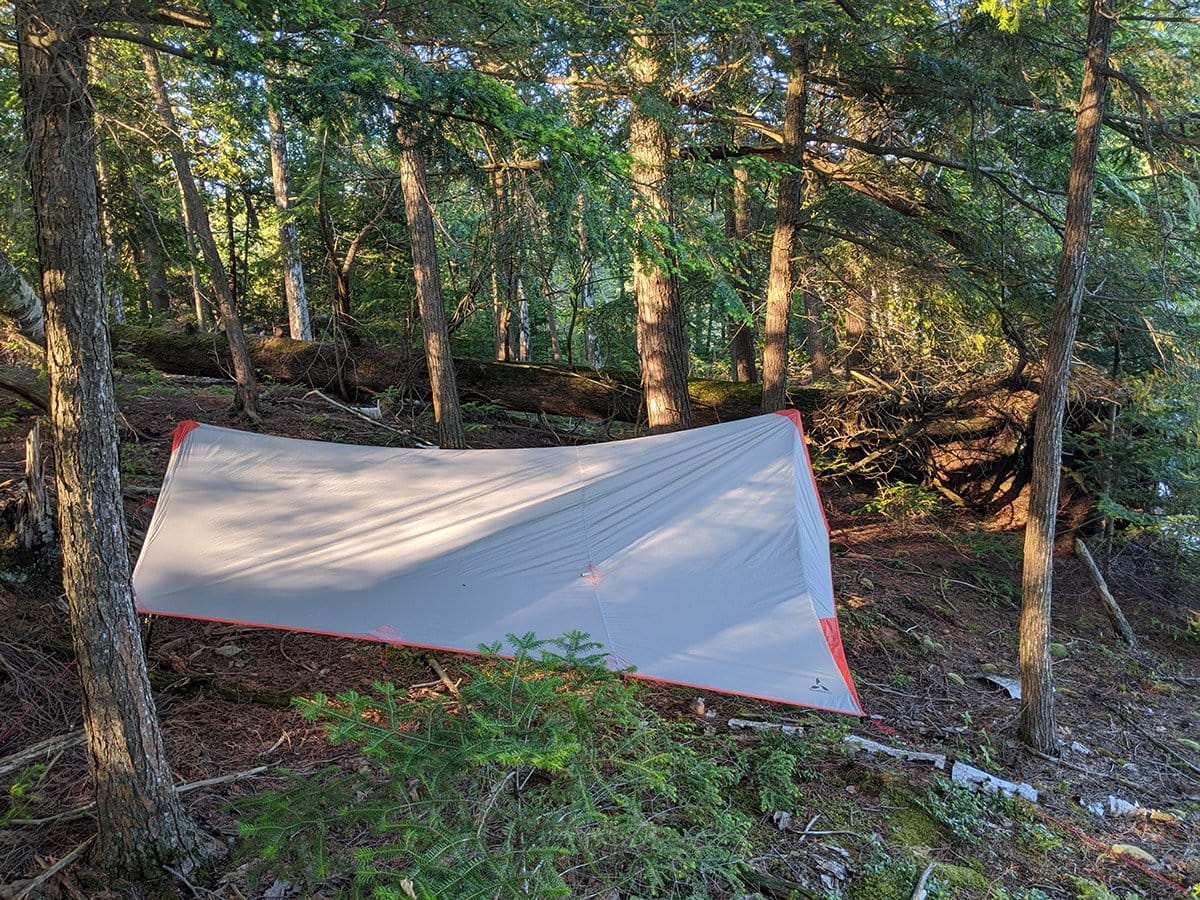
Photo by Dahn Pratt
Versatile – When temperatures soared, I pitched the tarp high for maximum ventilation; and when I was concerned about the potential for inclement weather, I pitched it low to the ground. The SplitWing can also be used (and indeed was used) as a hammock tarp with a ridgeline. I especially liked the ability of the tarp to pitch in precarious places e.g. on the edge of a lake near some heavily beaver chewed Birch trees.
Sets up taut – The tarp was very sturdy even without staking down all the extra guy-out-points. I have lots of confidence in the tarp in adverse weather conditions. Luckily for me, I have yet to experience such weather.
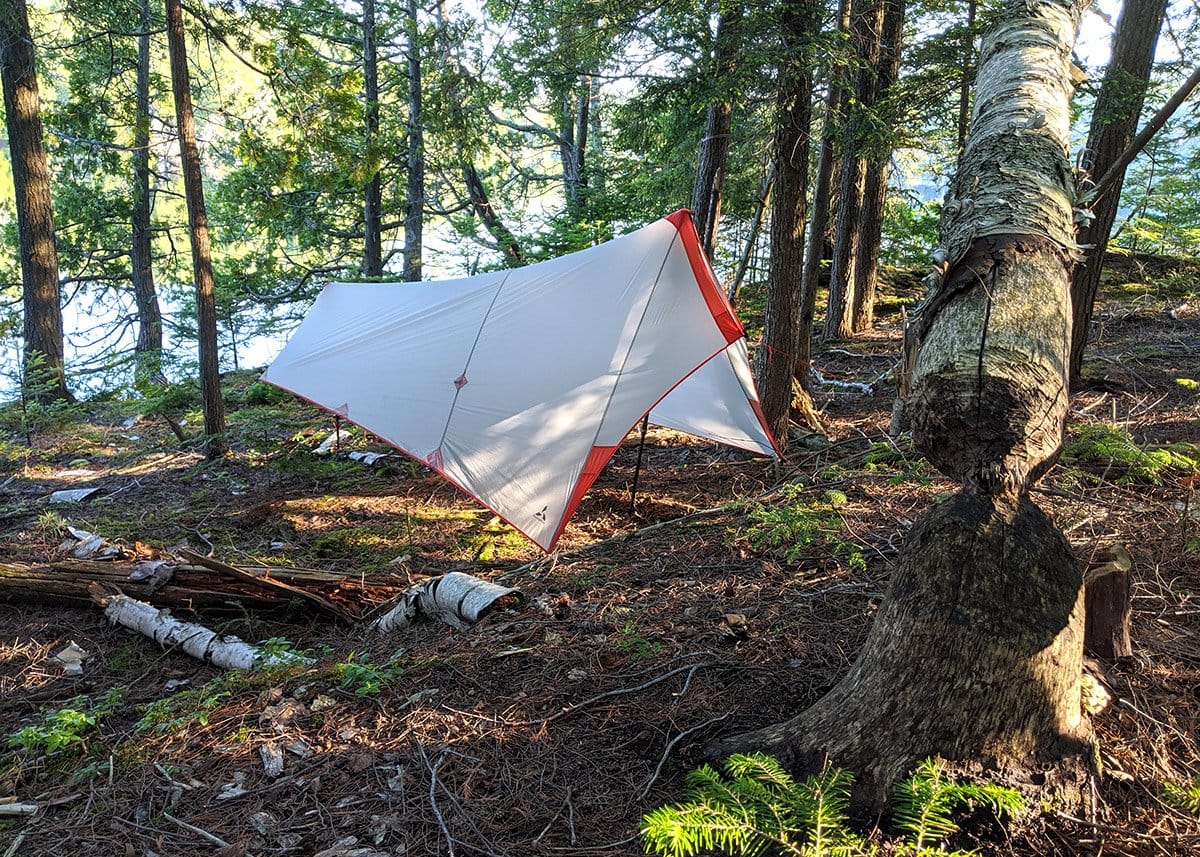
Photo by Dahn Pratt
Things to note:
Practice before you leave — in terms of setting up, at first I found it rather confusing, even after using tarps for thousands of trail miles. Perhaps I’ve forgotten a bit of geometry or need to cut my teeth some more on tarp pitches but it took a bit of head scratching as well as trial and error to get the pitch taut the first time around. All of that being said, the consecutive pitches afterwards were much faster and less confusing. Understanding how your gear works beforehand is one of the many pre-hike rituals I try to undertake to ensure a more pleasant outing — maybe I should heed my own advice more often.
After my initial confusion, and if we’re being honest, mild frustration, I realized I didn’t give the SplitWing a fair-shake having haphazardly set it up as fast as possible so I could escape the mosquito horde in favor of a swim in the northern Ontario lake that I chose as my basecamp.
It’s also worth mentioning that I mistakenly placed the bottom trekking pole (where my feet would go) UNDER the tarp instead of using the tie out and affixing the trekking pole TO the tarp.
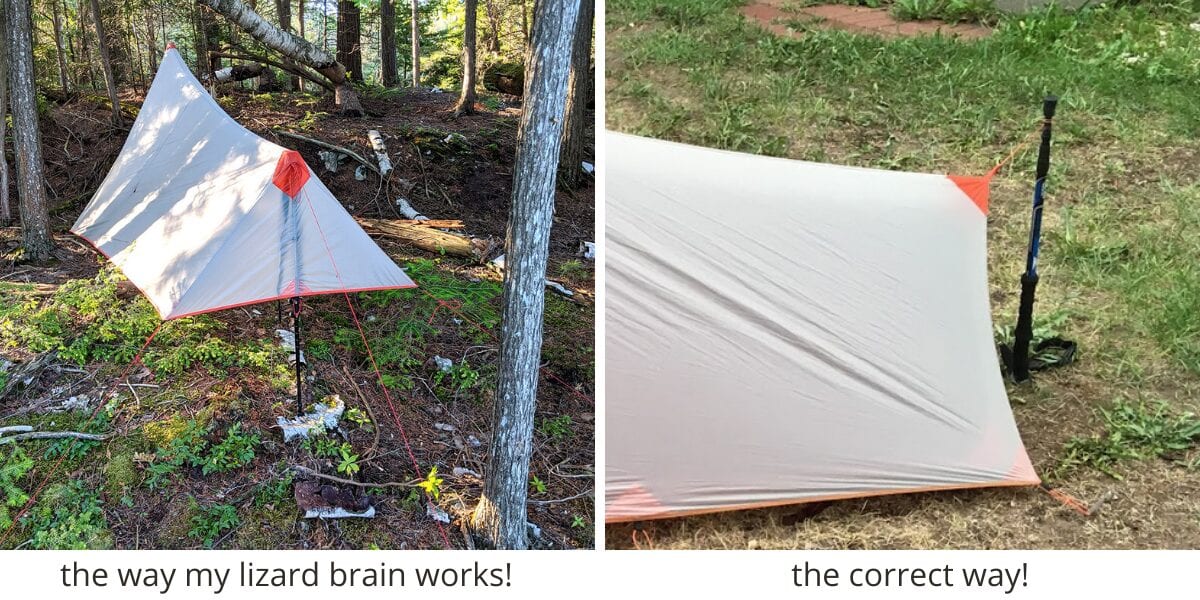
Photo by Dahn Pratt
Either way the tarp pitched exceptional well, even in the face of my obvious faux pas (a definite feather in the cap for SlingFin and a question mark for my mental capacities).
Another user error I ran into without instructions was guying out the wrong tie out points for the front end of the tarp. Instead of using guylines for the vestibule carabiners, I just attached them together. This made me question the weather-worthiness of the tarp (but in retrospect this was completely my fault).

Leaves you somewhat exposed – My one reservation is that the SplitWing Tarp (sans mesh, vestibule beak, footprint) may not protect from all the elements. At the very least I would recommend getting the vestibule beak as well to cover the tarp opening. However, us hikers are cheap, and creative. If you carry an umbrella, I believe it would be a great replacement to the vestibule beak with a similar effect, albeit a less form-factor-fitting component.
The Verdict:
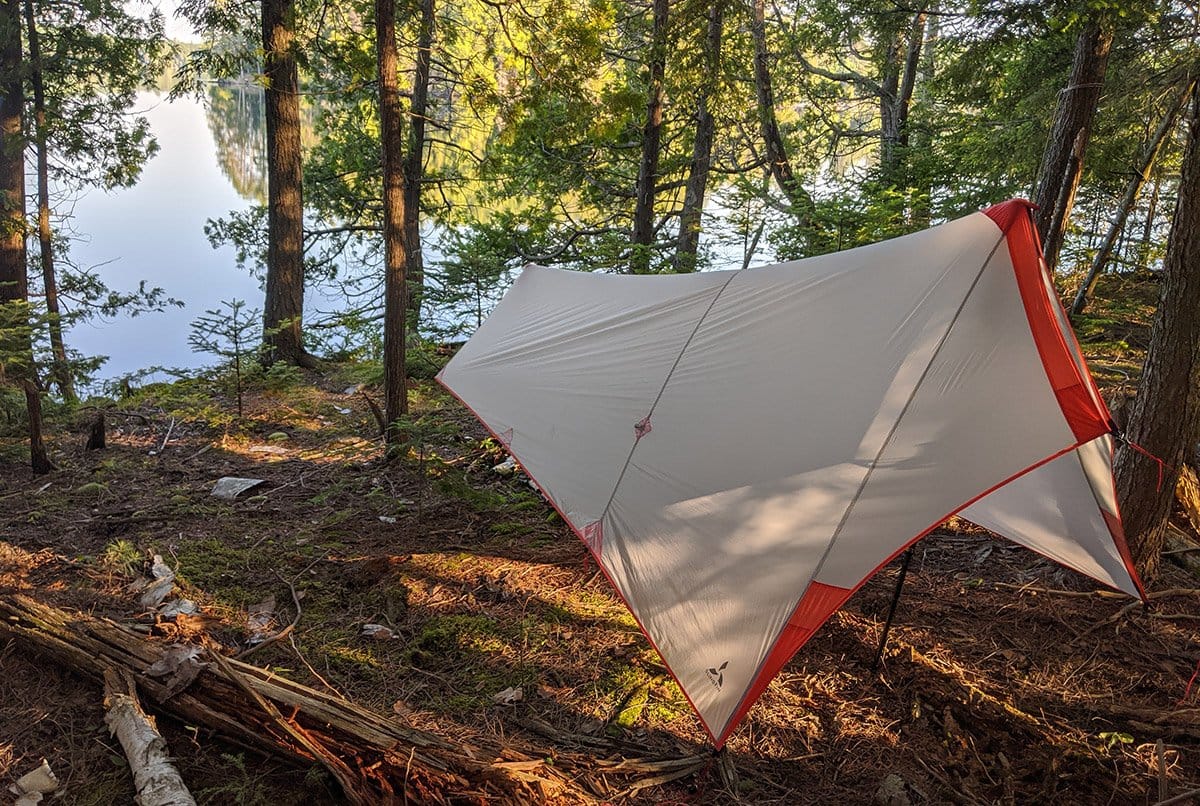
Photo by Dahn Pratt
Overall, I think this is an amazing value when considering cost, weight, performance, packability, protection from elements, and longevity. I’m looking forward to putting more miles on the SplitWing but for now I’ll enjoy my lake-side digs.
Author’s disclaimer: This tarp was given to me by Garage Grown Gear for the purpose of reviewing.
This article was originally written for Garage Grown Gear and can be found here.
Want to keep up with all that’s going on at Atlas Guides? Sign up for our newsletter!
Read more!
Check out some related blog posts!

Download our popular hiking and biking guides!


Trail guides that get you to places you’ve dreamed of.
As the makers of Guthook Guides, Bikepacking Guides, and Cyclewayz, we help you navigate the most popular trails around the world on your smartphone. Our hiking guides and biking guides work completely offline. Let Guthook guide your next adventure!
Showers Lake Vista, Tahoe Rim Trail
Photo courtesy of the Tahoe Rim Trail Association
About the Author

Dahn Pratt
Dahn is an avid taker-of-walks. He has hiked the Triple Crown of National Scenic Trails in the United States, Te Araroa in New Zealand, the Peace Trail through Jordan and Israel, and various other routes and trails around the world. His most recent escapades called “Chasing Summer” had him hiking long distance trails, oscillating between North and South Hemispheres in perpetual summer.


Thru-hiking Gear Review - Deschutes Zero-G Shelter
Planning an adventure? Check out our popular trail guides! 4.8 stars (17K+ ratings)
Photo provided by Dahn Pratt
Thru-hiking Gear Review: Deschutes Zero-G Shelter
On the Continental Divide Trail unpredictable weather conditions necessitate choosing gear wisely. A Triple Crown hiker explains his decision to bring a Deschutes Zero-G shelter on his 2019 thru-hike of the CDT.
Dahn Pratt Gear Review 03/20/2020
Dahn Pratt
Gear Review
03/20/2020
10,000 miles of Thru-Hiking
Gear; Deschutes Zero-G
Without much practice or knowledge of free-standing tarp-style shelters I brought what amounted to a thin sheet of fabric on my thru-hike of the infamously grueling Continental Divide Trail, a 3,000 mile hike from Canada to Mexico. It was my first foray into the ultralight textile known as Dyneema Composite Fabric (DCF), also known as cuben fiber, but the lightweight fabric proved to be the best piece of thru-hiking gear I used in 2020.
DCF is quickly becoming an essential item on any thru-hiking gear list, and as the popularity of the trails grow, the use of ultralight backpacking gear has also increased. Prior to my hike on the CDT, I was dubious of the practicality for such an expensive fabric. But within the first week of using it, I was a convert.
After a grueling day in the Bob Marshall Wilderness, with over 17,000 ft of elevation gain and 37 miles of tough trail, I settled in for the night, completely spent. It wasn’t my intention to go so far in a single day, especially since I was less than a week into my thru-hike of the CDT. But circumstances dictated I push on, as a majority of the day’s walk was spent above tree-line in very exposed terrain.

The southern end of the Bob Marshall Wilderness aka “The Bob” one of the most remote places in the contiguous US. Photo by Dahn Pratt
Just as the day was ending a thunderstorm began to brew overhead. This was a signal it was time to get somewhere relatively safe.

Photo by Dahn Pratt
As the blue skies turned to an angry gray, my hiking partner and I quickly descended from the exposed ridge to the relative calm of the lower elevations.
A small seasonal alpine tarn near Caribou Peak provided the first tree-cover for miles in any direction. The relief of being under some sort of cover for the first time during the moody weather I had come to expect from Montana was definitely welcomed.

Photo by Dahn Pratt
We had just enough time to crawl into our shelters before the skies began to unload on us. Quarter sized bullets of hail and ear-shattering thunder had me in a fetal position most of the night as frequent and terrifyingly close lightning lit up the interior of my tarp. The barrage lasted several hours and the fear of getting hit by lightning, having my shelter torn to shreds by hail and wind, or having a tree collapse on me all but insured a sleepless night.
In the morning we awoke to a calm, cloudless sky and my hiking partner Vortex looked at me perplexed. There were shards of glass around both of our shelters. A particularly large piece was near where my head had laid the previous night. We had cleared the site prior to putting our tarps down, which had become our thru-hiking ritual, and were dumbfounded to find the glass in our respective sites. Could we really have missed these sharp pieces of glass? We would later find out that the lightning strikes had hit the sandy beach of the small lake we slept beside, fusing the sand into silica glass.
From that day forward, I knew my shelter was bomb-proof!
The Deschutes Zero-G is a DCF shelter with a stated weight of 8 oz (226 grams) although my scale read 222 grams or about 7.8 oz (including the stuff sack but excluding stakes and pole).

Photo by Dahn Pratt
The set-up is pretty intuitive as the shelter only uses a single pole, which was a major draw for me (I have a tendency to snap trekking poles). Even with no real tarp experience, my first time setting it up took ~5 minutes to get a taught pitch.

Quick, easy, and taut pitch, everytime! by Dahn Pratt
Deschutes Zero-G + SerenityNet inner. A fully enclosed double-walled shelter at 19 oz. Photo by Dahn Pratt
Using a piece of Tyvek as a groundsheet and a SMD Serenity Net provided me with a fully enclosed double-walled shelter. The added benefit being the modular nature of having a detachable inner for clear nights or just the Deschutes for bugless nights.
One of the reasons I absolutely loved the Deschutes was its ability to pitch in precarious spots. With its tiny footprint, most sites that would otherwise be off-limits to other hikers were perfect “nests” for me.

After crossing the Wyoming/Colorado border the deadfalls limited safe camping areas, but it had no material impact on the small footprint my Deschutes took up
Photo by Dahn Pratt

With nowhere flat and plantless to set up in the Great Divide Basin, I had to set up shop on a seemingly endless dirt road.
Photo by Dahn Pratt
After proving its worth in the berserk weather of the Divide, I spent the next ten months across seven countries and 5,000 miles with the Deschutes Zero-G as my roof. Completing a year of back-to-back thru-hikes made me more comfortable and well versed in the outdoors than ever before. With this new-found sense of confidence and the Deschutes in my pack, I never doubted its ability in any condition. The increasingly precarious and outright ridiculous places where it was able to perform exceptionally well warranted its new nickname as my “all-terrain vestibule”.

The Deschutes Zero-G in an epic off-trail campsite in sub-Antarctic Patagonia.
Photo by Dahn Pratt

Even with furious winds and constant rain I always stayed dry and cozy inside my “hiker’s nest”. Photo by Dahn Pratt
Author’s disclaimer: This tarp was given to me by Six Moon Designs as part of their Ambassador’s program in 2019
Want to keep up with all that’s going on at Atlas Guides? Sign up for our newsletter!
Read more!
Check out some related blog posts!
Get our trail guide for this area!
Continental Divide Trail
Considered by many to be the most remote and challenging of the triple crown trails, the Continental Divide Trail is a 3100 mile adventure through five western states.
3100 mi (4980 km) $39.99 full guide
Colorado, Continental Divide Trail
Photo by David Getchel
Colorado, Continental Divide Trail
Photo by David Getchel
Continental Divide Trail
Considered by many to be the most remote and challenging of the triple crown trails, the Continental Divide Trail is a 3100 mile adventure through five western states.
3100 mi (4980 km)
$39.99 full guide
Get our trail guide for this area!
About the Author
Dahn Pratt
Dahn is an avid taker-of-walks. He has hiked the Triple Crown of National Scenic Trails in the United States, Te Araroa in New Zealand, the Peace Trail through Jordan and Israel, and various other routes and trails around the world. His most recent escapades called “Chasing Summer” had him hiking long distance trails, oscillating between North and South Hemispheres in perpetual summer.
